
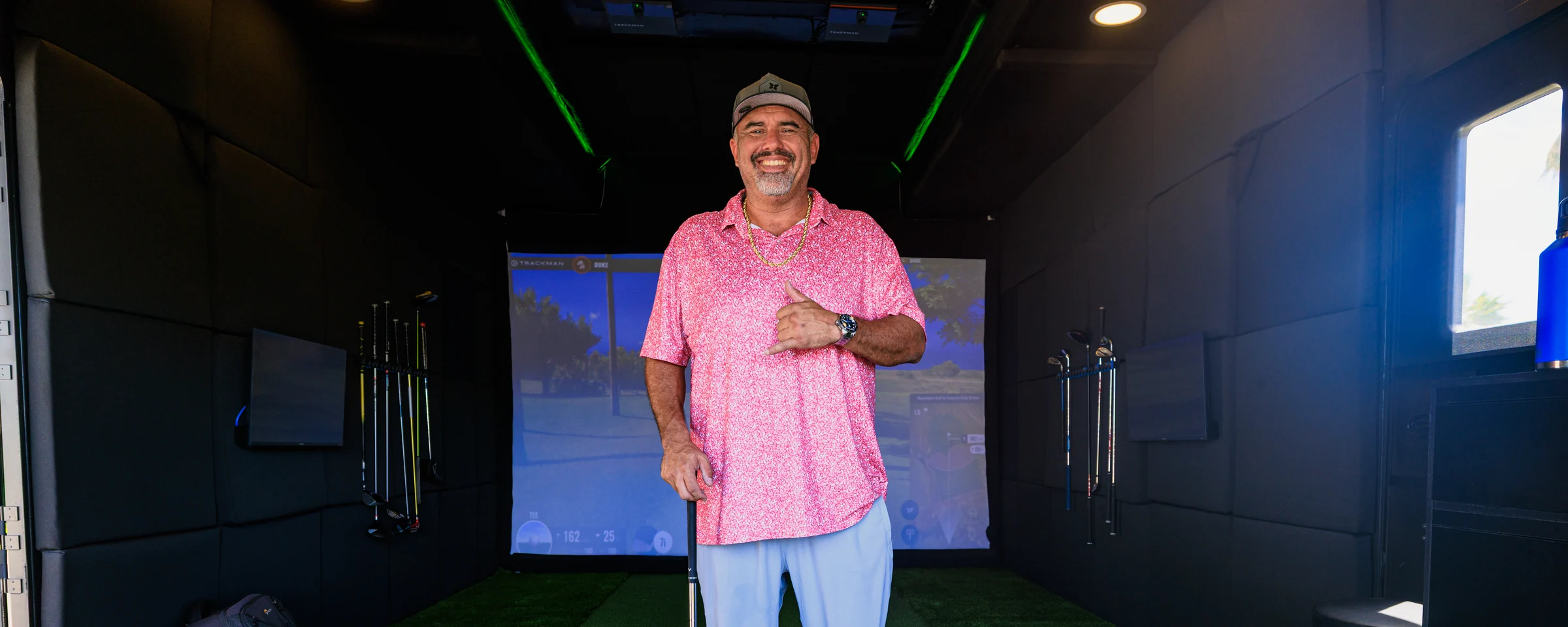
A golf simulator measures your real swing and the opening split second of the ball's flight, then calculates where that shot would have gone and plays it out on the screen. In the SwingLab trailer, the measuring is done by a TrackMan unit mounted above the hitting mat, and the hole on the screen comes from a library of 400+ courses.
A garage setup and a tour fitting studio are built from the same three pieces. What separates them is how well the launch monitor measures.
This is the sensor that reads the club and the ball at impact. Everything you see afterward, the carry, the curve, the roll, is worked out from what it captures in that moment. It is the part that decides how close a simulator gets to a real shot.
You swing a real club at a real ball off a turf mat, and the ball flies a few steps into an impact screen. The screen shows the hole you are playing, then the shot as it travels down the fairway.
The software takes the measurements, calculates the flight and places the ball on the course. It also keeps score, so a round or a contest ends with a leaderboard instead of an argument.
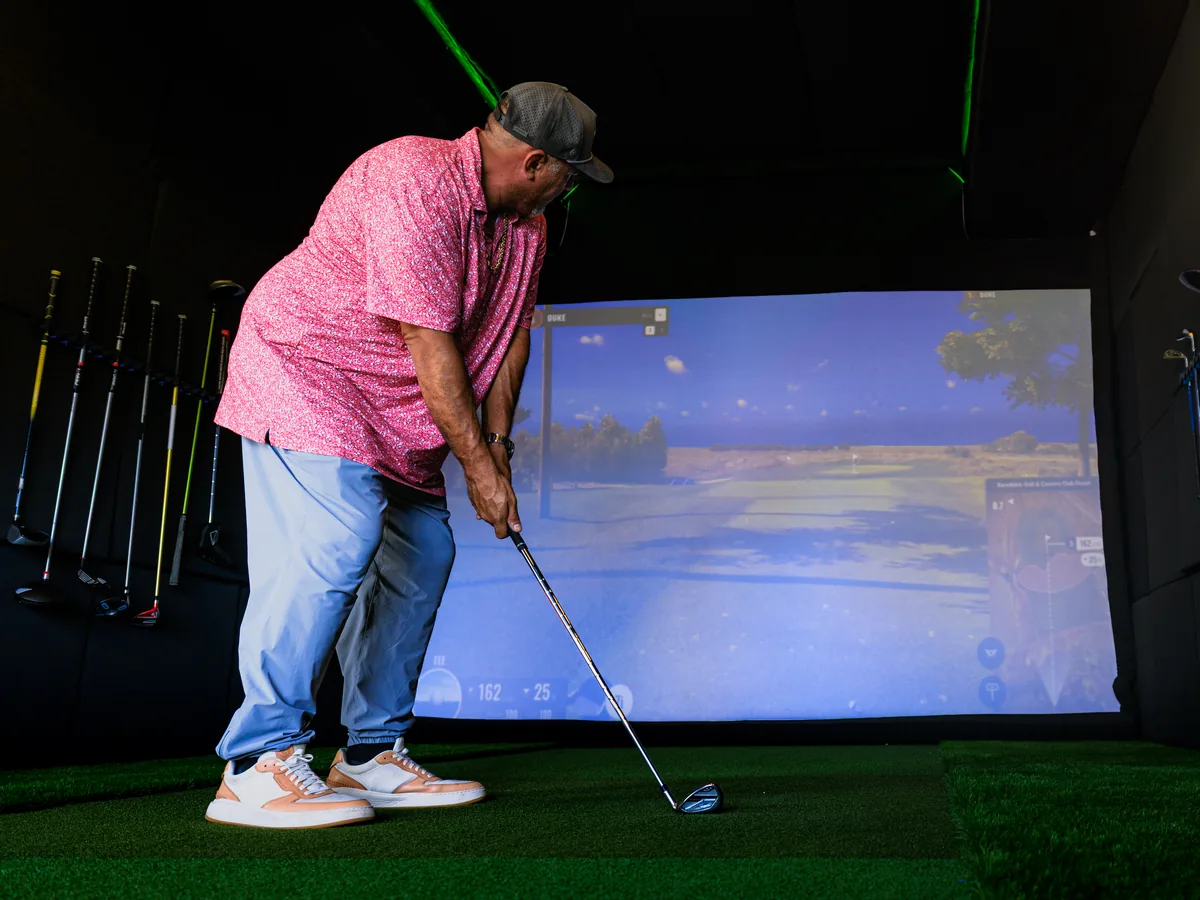
Nothing about the swing is simulated. Clubs for right- and left-handed players are in the trailer, so nobody needs to bring a bag.
The unit in the trailer hangs overhead, out of the way of the club. TrackMan builds its indoor system around two sensors that check each other: a radar and a high-speed camera.
TrackMan's spec sheet lists a high-speed camera that runs up to 4,600 frames per second to track the club and the ball. Its co-founder puts it simply: "We get the angles from the camera, and the radar essentially gives us the depth information."
A 24 GHz radar measures how fast things are moving and how far away they are. Radar measures speed directly, which is why TrackMan pairs it with the camera instead of asking several cameras to estimate depth.
An infrared light system built into the unit lights the club and ball, so the room lighting does not matter. It sits outside the visible spectrum, so you never see it flash.
Some launch monitors need reflective dots on the club or marked balls. TrackMan says its cameras recognize the club itself, down to the grooves and score lines, and that any ball works. It also recalibrates every time it starts by projecting a pattern onto the impact screen, so the aim line is set before anyone swings.
TrackMan's spec sheet lists 14 ball measurements and up to 9 club measurements, depending on the setup. The ones you will see most on the screen:
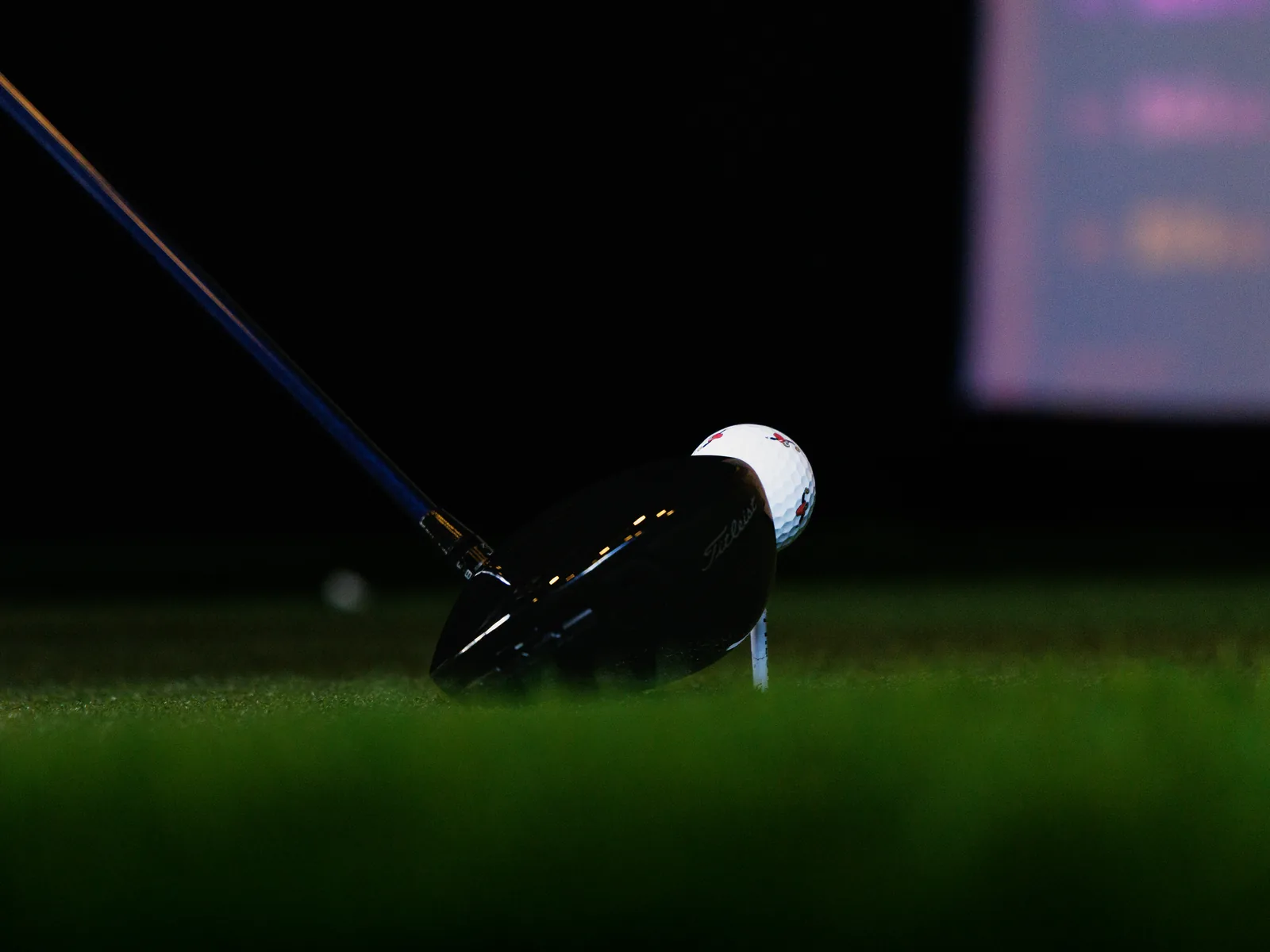
The ball travels just a few feet before it hits the screen. Everything after that is calculated. Launch speed, launch angle and spin go into the ball flight model, and the software works out how high the ball climbs, how much it curves and where it lands and rolls on the course you picked.
That is why the measuring matters more than the graphics. A small misread on spin or launch direction grows the farther the ball is supposed to travel, so a shot that looks fine at the screen can finish in the wrong spot on a long hole.
Two things: the sensor and the setup. Systems built on cameras alone work out depth by comparing views from several cameras, and TrackMan argues that pairing a camera with radar measures speed and depth more directly. Setup is the other half. If the mat and the screen are out of line, every shot reads crooked, which is the problem the automatic startup calibration is there to solve.
The same numbers that drive a party game drive a lesson. In a TrackMan coaching session they show exactly what changed between one swing and the next.
The TrackMan library in the trailer holds over 400 courses, including championship layouts like Pebble Beach and St Andrews. You can play a few holes, or skip the round and run a game.
Most golf simulators sit in a building, and you drive to them. The SwingLab trailer is a complete bay on wheels: it expands on site to about 15 feet wide by 40 feet long, it is climate-controlled with AC and heat, and it is ready to play about 15 minutes after it arrives. Screens inside and out on the party deck show the shot data and the leaderboard, so the people waiting their turn can follow every swing.
One person hits at a time, and groups of four to six usually rotate through together while the host keeps the line moving. See the trailer and its setup, or how a mobile golf simulator booking works from quote to teardown.
You do not need to be a golfer. The host shows new players where to stand and what to look at on the screen, and the numbers after each swing make it easy to see what changed on the next one. That is a big part of why simulators work at birthday parties and weddings, golf bachelor parties and company team days: the people who have never played are usually the loudest at the leaderboard.
Send the date, the place and a rough guest count. We confirm most dates within 24 hours.